Golden Shilajit Official | EUROFINS Tested | Pure Himalayan Shilajit Resin

Shilajit Price in Pakistan 2026 | Lab-Tested Resin Price Guide
Shilajit Price in Pakistan 2026: Compare product sizes, lab testing, cost differences and current Golden Shilajit prices with nationwide COD.
Written By: Dr. Hamza Nutraceutical Research Specialist Golden Shilajit Official Research Team
6/2/202617 min read
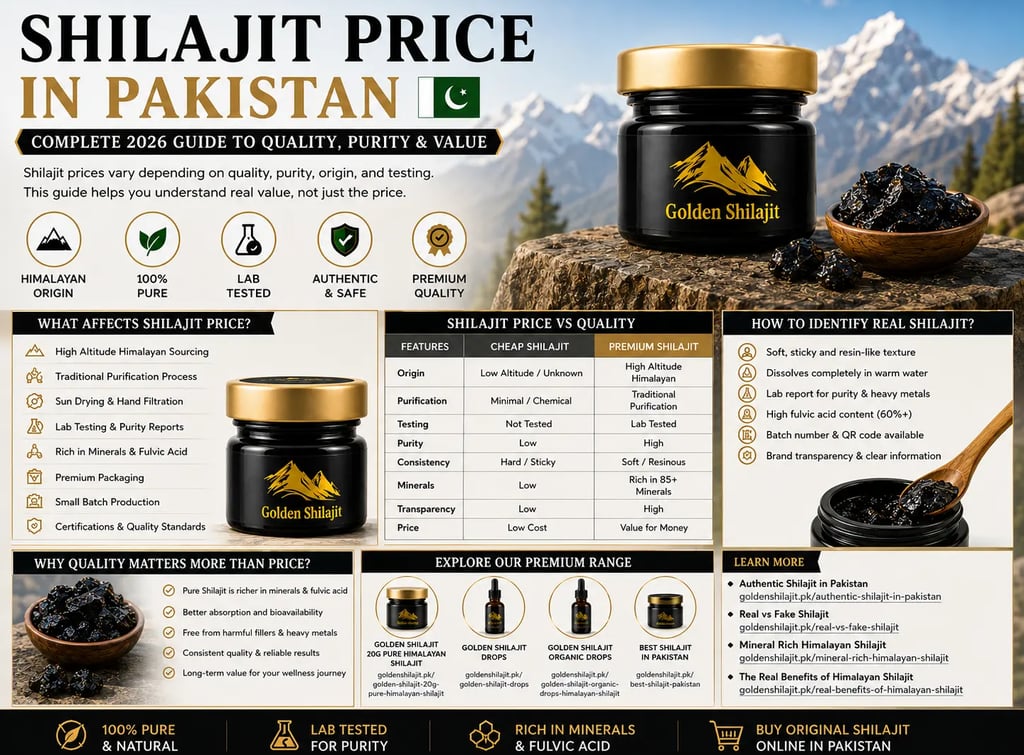
Shilajit Price in Pakistan 2026: What Does Quality Shilajit Cost?
If you have spent any time searching for Shilajit in Pakistan, you have probably noticed something confusing: the prices are all over the place. One seller offers a 20g jar for Rs 500, another asks Rs 3,000 for what looks like the same thing, and a bulk listing quotes Rs 85,000 per kilogram. How can a single product vary this much? The short answer is that not all "Shilajit" on the market is actually pure Shilajit, and the gap between the cheapest and the most expensive options usually reflects a real difference in sourcing, purification, and testing rather than simple markup.
Shilajit prices in Pakistan vary for several legitimate reasons. The raw material is harvested by hand from remote high-altitude rock faces, then purified, sun-dried, and (in the case of trustworthy brands) sent to an independent laboratory to confirm it is free of heavy metals and contains the fulvic acid it claims. Each of those steps adds genuine cost. A seller who skips them can advertise a much lower number, but the product in the jar is rarely the same thing.
This is where quality matters more than price. Shilajit is something you put into your body, often daily and over months. A cheap jar that has been bulked out with coffee, chocolate, or pine resin, or that carries traces of heavy metals from improper purification, is not a bargain at any price. The aim of this guide is not to push you toward the most expensive option on the shelf, but to help you understand exactly what you are paying for so the price finally makes sense.
The biggest misconception in this market is that "Shilajit is Shilajit," so the cheapest jar is the smart buy. In reality, the cheapest products are usually the riskiest, because the savings come directly out of the purification and testing budget. Throughout this guide we will look at the current price ranges, the factors that drive cost, how to spot the real thing, and which questions to ask before you hand over any money.
What Is Shilajit?
Shilajit is a sticky, tar-like resin that seeps from cracks in rock faces in high mountain ranges, including the Himalaya, the Karakoram, and the peaks of Gilgit-Baltistan. In Urdu and Persian it is known as salajeet. It is not mined like a mineral or grown like a herb. Instead, it forms slowly over centuries as plant and organic matter is compressed between layers of rock at high altitude and gradually transformed by pressure, microbial activity, and temperature cycles. During the warm summer months, this material softens and oozes out of the rock, where it is collected by hand.
Chemically, authentic Shilajit is valued for three main components. The first is fulvic acid, a small, highly absorbable organic molecule. The second is humic substances, a related family of organic compounds. The third is a broad spectrum of trace minerals, which is why pure Himalayan Shilajit is often described as mineral rich. Premium liquid extracts and resins are frequently marketed as containing 80 or more trace minerals alongside fulvic and humic compounds. If you want a deeper look at this composition, the explainer on Shilajit benefits and composition breaks down what these components are and why they are central to authenticity.
Shilajit has a long history in traditional wellness systems such as Ayurveda and Unani, where it has been used for generations. It is important to be clear here: traditional use is not the same as proven medical treatment, and reputable brands in Pakistan note that statements about Shilajit have not been evaluated by drug regulators. This guide treats Shilajit as a natural wellness supplement, not a medicine. For an honest, non-exaggerated overview of how it is used and what people commonly look for from it, see the discussion of fulvic acid and the benefits of Himalayan Shilajit.
The form you buy also matters. Resin is the traditional, most concentrated form and is what most experienced users prefer. Liquid drops are a newer, more convenient format made from purified resin, designed to dissolve quickly and dose precisely. Capsules and powders also exist. Each form sits at a different price point, which is part of why a single "Shilajit price" is impossible to quote.
Current Shilajit Price Range in Pakistan
Prices in 2026 depend heavily on form, pack size, purity, and whether the product is independently lab tested. The figures below reflect the typical ranges seen across the Pakistani market this year. Treat them as approximate guides rather than fixed numbers, because prices move with the rupee, sourcing costs, and demand. Always confirm the current price and the lab report directly with the seller before buying.
At the very bottom of the market you will see "Shilajit" advertised for only a few hundred rupees, often under Rs 800 for a small jar. These are best avoided altogether: at that price the product is almost always unpurified, untested, or adulterated. As a rule of thumb that holds across the Pakistani market, genuinely authentic resin in the popular 20g to 30g range does not sell below roughly Rs 3,000. Anything cheaper than that for that quantity should be treated as a warning sign rather than a deal.
Moving up from there, prices climb with quantity and, more importantly, with whether the resin has been properly purified and independently tested batch by batch. For genuinely pure, lab-verified Himalayan resin, the realistic 2026 figures look like this: a 10g jar runs approximately Rs 1,900 to Rs 2,300, a 20g jar approximately Rs 3,800 to Rs 4,250, a 30g jar around Rs 6,450 to Rs 6,500, and a premium 50g jar between roughly Rs 9,000 and Rs 11,000. Purified liquid Shilajit typically falls between about Rs 5,600 and Rs 5,900. These figures reflect resin that is fully purified and tested batch by batch at internationally recognised laboratories such as Eurofins USA, SGS, and ARL USA, which is precisely why they sit well above the budget products you will find elsewhere. The testing and purification are the cost, and they are also the reason the product is safe to take daily.
It is worth being clear about why these numbers are higher than the rock-bottom listings flooding the market. A jar of "Shilajit" at a few hundred rupees has skipped the very steps these prices pay for. When you see authentic, batch-tested resin, you are looking at the true cost of hand-harvested material that has been purified and independently verified, not marked up for the sake of it. For most buyers, a 10g jar is a sensible way to verify quality first, after which the 20g and 30g jars offer progressively better value per gram for regular daily use.
Other formats and bulk sit at their own price points. Capsules across the wider market typically range from about Rs 1,200 to Rs 3,500 depending on the count and brand, though these vary widely in actual purity. For resellers, stores, or long-term households, bulk resin is sold by the kilogram, usually starting around Rs 60,000 and climbing to Rs 85,000 or more for premium gold-grade material.
Golden Shilajit's resin and drops sit squarely in this authentic, fully tested tier rather than the suspiciously cheap bracket. Every batch is verified by Eurofins Laboratories USA, with additional testing through labs such as SGS and ARL USA, and a recent report confirmed 45.39% fulvic acid with zero heavy-metal contamination. That batch-by-batch verification is the single clearest reason the pricing reflects genuine purified resin rather than an untested lookalike.
A useful way to compare honestly is price per gram rather than sticker price. Across these authentic, lab-tested options the cost works out to roughly Rs 190 to Rs 230 per gram, and the larger jars generally edge out the smaller ones on value, which is why committed daily users tend to move up to the 30g or 50g size once they have confirmed quality. A jar that looks cheaper on the shelf but is untested, or a Rs 500 jar whose contents are unverified, is not actually cheaper in any meaningful sense, because you cannot be sure what you are buying. When you are comparing options, it is worth looking at the brand's flagship resin, such as Golden Shilajit 20g pure Himalayan Shilajit, and dividing the price by the weight so you are comparing like with like.
Why Some Shilajit Is So Cheap
When you see Shilajit advertised for a few hundred rupees, it is reasonable to ask how that is even possible. The honest answer is that the price is low because something was left out, and usually that something is the part that makes Shilajit safe to consume.
The most common reason is adulteration. Cheap products are frequently bulked out with inexpensive fillers that mimic the colour and texture of Shilajit, such as chocolate, coffee, ash, clay, pine resin, or even shoe-polish-grade compounds. These add weight and visual similarity at almost no cost, but they offer none of the fulvic acid or mineral content that defines real Shilajit.
The second reason is skipped purification. Raw Shilajit straight from the rock contains sand, grit, plant debris, and potentially heavy metals absorbed from the surrounding stone. Proper purification involves dissolving, filtering across multiple stages, removing sediment, and then slowly drying the material, often by sun dehydration over many days. This is labour intensive and reduces the final yield, which raises the cost. A seller who skips it can sell more cheaply, but the product may carry contaminants that pose real health risks.
The third reason is the absence of lab testing. Independent testing for heavy metals, microbial contamination, pesticide residue, and fulvic acid percentage costs money per batch. Sellers offering rock-bottom prices almost never pay for it, which means there is no objective proof of what is in the jar. Shilajit sold for under roughly Rs 500–800 has, in most cases, skipped purification, testing, or both.
Finally, some cheap products are simply mislabelled in terms of origin or grade. "Himalayan" and "pure" are unregulated marketing words, so a low-grade or non-Himalayan product can carry the same label as a premium one. The price is the clearest signal here: if it seems too good to be true for a hand-harvested, purified, tested natural resin, it almost always is.
What Determines the Price of Authentic Shilajit
Once you understand why cheap Shilajit is cheap, the price of authentic Shilajit stops looking like a markup and starts looking like a sum of real costs. Here are the main factors that determine what genuine, premium Shilajit costs in Pakistan.
Mountain sourcing. Authentic Shilajit is harvested by hand from remote rock faces, often in Gilgit-Baltistan, Skardu, Chitral, and the wider Karakoram and Himalayan ranges. Reaching these sites, collecting the raw resin, and transporting it is slow, seasonal, and labour intensive. Material from prized regions, such as Chitral or Skardu, often commands a premium because of its reputation for quality and fulvic acid content.
Altitude. Shilajit collected from higher altitudes is generally considered more potent and is harder to obtain. The most premium products are frequently sourced from elevations above 16,000–17,000 feet, where access is difficult and yields are limited. Higher altitude usually means higher cost, both because of the difficulty of collection and the perceived quality of the resin.
Purification. The multi-stage filtration process that removes grit, sediment, and contaminants is one of the single biggest cost drivers. A genuine four-step (or more) purification process requires equipment, expertise, time, and a reduction in usable yield. This is exactly the step that cheap sellers cut, and it is exactly the step that makes the product safe.
Sun drying. Many premium producers finish their resin with a slow sun-dehydration process that can take weeks. This traditional method concentrates the resin and preserves its naturally occurring compounds without harsh heat. It is time-consuming and weather-dependent, which adds to the cost but also to the quality.
Laboratory testing. Reputable brands send each batch to an independent, internationally recognised laboratory to screen for heavy metals, microbial safety, pesticide residue, and fulvic acid percentage. Some Pakistani brands use PCSIR locally, while premium exporters use international labs such as Eurofins. A batch-specific Certificate of Analysis (COA) is the only objective proof that what is on the label matches what is in the jar, and it is a recurring cost paid on every batch.
Packaging. Shilajit is sensitive to light, heat, and air. Quality producers use dark amber glass jars or bottles, food-grade dropper bottles for liquids, and tamper-evident seals to protect potency. Proper packaging costs more than a generic plastic tub, but it preserves the product you paid for.
Certifications. Certifications such as ISO 22000, GMP, Halal, Non-GMO, and athlete-focused programmes like BSCG signal that the producer follows documented quality and safety standards. Earning and maintaining these certifications is an ongoing expense that is reflected in the final price, but it also gives buyers a meaningful layer of assurance.
When you add these factors together, the gap between a Rs 500 jar and a Rs 3,000 jar becomes easy to understand. You can read more about how these standards translate into a verifiably genuine product in the guide to buying pure, lab-tested Shilajit in Pakistan.
Shilajit Price vs Quality Comparison
To make the trade-offs concrete, the table below compares three broad tiers you will encounter in the Pakistani market. The point is not that expensive is always best, but that the price usually tells you which corners were or were not cut.
Cheap or suspicious products (under roughly Rs 800). These come from unknown or unverified origins, with little or no purification and no lab testing at all. Heavy metals are never screened, the fulvic acid content is unknown and unproven, and the adulteration risk is very high. They usually arrive in generic plastic packaging with no certifications of any kind. The honest verdict on this tier is simple: avoid it.
Mid-range products (roughly Rs 1,500 to Rs 3,000). These are often genuine but undocumented. Purification tends to be basic, and lab testing is inconsistent or unverifiable, which means heavy-metal screening and fulvic acid claims are made but rarely backed by a report you can check. Adulteration risk is moderate, packaging is mixed, and certifications are rare. This tier can be acceptable, but only if the seller can produce a real, batch-specific lab report and explain exactly where the resin comes from.
Premium, lab-tested products (the authentic tier, typically Rs 1,900 and up depending on size). Here the sourcing is documented to specific high-altitude regions of the Himalaya and Karakoram, and the resin goes through multi-stage filtration and proper sun drying. Each batch carries a Certificate of Analysis from a recognised laboratory, with heavy metals screened and reported in parts per million and the fulvic acid percentage verified rather than merely claimed. Adulteration risk is low, the product is packaged in light-protected amber glass and sealed, and certifications such as ISO, GMP, Halal, Non-GMO, and BSCG are common. This is the tier suited to daily users who prioritise safety and consistency.
The middle tier can be acceptable if, and only if, the seller can back up their claims with a real lab report and clear sourcing. The premium tier is where you find the strongest verification. For a look at what a top-tier option looks like in practice, you can browse Golden Shilajit's lab-tested range and compare the markers that separate a genuinely premium product from one that merely charges a premium price.
How to Identify Real Shilajit Before Buying
You do not need a laboratory to do a first round of screening. A combination of simple at-home checks and documentation review will filter out most fakes. No single test is conclusive on its own, so use several together.
The warm water test. Dissolve a pea-sized piece in warm (not boiling) water. Genuine Shilajit dissolves fully and turns the water a golden-brown to reddish colour, leaving little or no residue, because pure fulvic acid is water soluble. Fakes and heavily adulterated products tend to leave grit, oil, or a sediment that settles at the bottom.
The temperature test. Authentic resin responds to temperature. Held in your hand, it softens and becomes pliable and sticky from body heat. Placed in the fridge or freezer, it hardens and can become brittle. A product that stays exactly the same texture regardless of temperature is a warning sign of synthetic fillers.
The taste and smell. Real Shilajit has a strong, bitter, earthy, slightly smoky taste and a distinctive mineral aroma. Products that taste sweet, like chocolate or coffee, or have no real character, are usually adulterated.
The solubility and flame checks. Pure resin should not be sticky-greasy in a way that suggests added oils, and it should not burn or bubble like plastic when exposed to a flame (a check best left to experienced sellers, not done casually at home).
The documentation. This is the most important step and the one fakes cannot pass. Ask for a batch-specific Certificate of Analysis showing heavy metal readings and fulvic acid percentage, confirm the lab is real and independent, and check for certifications. A seller who cannot or will not show you a current lab report is asking you to trust marketing words alone.
If you want to confirm what genuine resin should look like against the figures, Golden Shilajit's published lab reports are a practical reference to keep open while you evaluate a product.
Should You Buy Cheap or Premium Shilajit?
This is the question most buyers are really asking, and the honest answer is nuanced. Price alone is a poor guide in either direction. A high price does not guarantee quality, and a low price almost guarantees a problem.
The case against the cheapest options is straightforward. When Shilajit costs less than the raw material, hand-harvesting, purification, and testing would reasonably allow, the savings have come out of safety. The risk is not just that you wasted a few hundred rupees on a coffee-and-clay lookalike, but that you are consuming an unverified product that may contain heavy metals. For something you take daily, that risk is not worth the saving.
The case for premium is not about prestige. It is about verification. When you pay for a lab-tested, certified product, you are buying a documented chain of evidence: this is where the resin came from, this is how it was purified, and this is the independent report confirming what is inside. That assurance is the actual product. Premium resin is also concentrated, so a pea-sized daily dose means a quality jar lasts a long time, which narrows the real cost gap considerably once you calculate cost per day rather than cost per jar.
For most buyers, the sensible path is to avoid the bottom of the market entirely, choose a mid-to-premium product that comes with a genuine lab report and clear sourcing, and judge value on cost per gram and cost per day rather than the headline price. A trial-size jar from a credible brand is a reasonable way to verify quality before committing to a larger, better-value pack. If convenience matters more to you than the traditional resin format, a precisely dosed liquid such as Golden Shilajit organic drops can be an easier entry point for users who want a higher-strength liquid extract.
Questions to Ask Before Buying Shilajit in Pakistan
Before you pay, run the seller through this checklist. A trustworthy brand will have clear answers to all of these. Hesitation or vague responses are themselves an answer.
Where exactly is your Shilajit sourced from? Look for a specific region (Gilgit-Baltistan, Skardu, Chitral, Karakoram) and an indication of altitude, not just "the Himalayas."
Can you show me a recent, batch-specific lab report? The report should match the batch you are buying, not a generic certificate from years ago.
Which laboratory does the testing? Confirm it is independent and recognised, whether that is PCSIR in Pakistan or an international lab such as Eurofins.
What is the fulvic acid percentage? A real brand will state a number and have it on the report.
Have you tested for heavy metals, and what were the readings? Ask for results in parts per million, not just a "passed" claim.
How is the product purified? You want to hear about multi-stage filtration and proper drying, not "it comes straight from the mountain."
What certifications do you hold? ISO 22000, GMP, Halal, and Non-GMO are meaningful signals.
How should it be stored, and what is the shelf life? A brand that knows its product can answer confidently.
What is the price per gram, not just per jar? This is how you compare options fairly.
Is there a return or money-back guarantee, and how do I reach support? Confidence in the product usually comes with confidence in standing behind it.
Is cash on delivery available, and do you ship nationwide? Useful for buyers who want to inspect before paying.
Who legally owns and operates the brand? A registered company behind the product adds accountability.
Frequently Asked Questions
1. What is the average price of pure Shilajit in Pakistan in 2026? For genuinely purified, batch-tested resin, expect roughly Rs 1,900–2,300 for a 10g jar, Rs 3,800–4,250 for a 20g jar, around Rs 6,450–6,500 for a 30g jar, and Rs 9,000–11,000 for a premium 50g jar. Purified liquid Shilajit typically falls between about Rs 5,600 and Rs 5,900, and 1kg bulk orders run from around Rs 60,000 upward. Prices shift with the rupee and demand, so always confirm the current figure with the seller.
2. Why is some Shilajit so much cheaper than others? Because the cheapest products usually skip purification and lab testing, or are bulked out with fillers like coffee, chocolate, or clay. Those omissions cut cost dramatically but remove exactly the steps that make Shilajit safe. A jar under about Rs 500–800 has almost certainly cut corners somewhere important.
3. Is expensive Shilajit always better? Not automatically. A high price does not guarantee quality on its own. What you are really paying for in a premium product is verification: documented sourcing, proper purification, and an independent lab report. Judge a product by its evidence, not just its price tag.
4. How can I tell if Shilajit is real before I buy? Use several checks together: the warm water test (genuine resin dissolves into a golden-brown solution), the temperature test (it softens with body heat and hardens when cold), and a strong bitter, earthy taste. Most importantly, ask for a batch-specific lab report. A detailed walkthrough is available in the guide to buying pure, lab-tested Shilajit.
5. What is the difference between Shilajit resin and drops? Resin is the traditional, concentrated form preferred by experienced users. Drops are a liquid extract made from purified resin, designed for convenient and precise dosing in water or milk. Both can be high quality; the choice comes down to preference and routine.
6. What does a fair price per gram look like? For authentic, fully purified and lab-tested resin in Pakistan, the cost typically works out to roughly Rs 190 to Rs 230 per gram, with larger jars usually offering slightly better value. Comparing cost per gram, rather than the sticker price, is the fairest way to evaluate options, and it also exposes products priced suspiciously below this range.
7. Is cheap Shilajit dangerous? It can be. Unpurified or adulterated products may contain sand, plant debris, fillers, or heavy metals absorbed from the source rock. Because Shilajit is taken regularly, an unverified cheap product is a genuine risk rather than a smart saving.
8. What should I look for on a lab report? A batch-specific report should show heavy metal readings (ideally in parts per million), microbial safety, and fulvic acid percentage, from a named, independent laboratory. A generic or undated certificate is not enough.
9. Where in Pakistan is the best Shilajit sourced? The most prized material comes from high-altitude regions such as Gilgit-Baltistan, Skardu, and Chitral, within the Himalayan and Karakoram ranges. Higher altitude and reputable regions generally command a premium. You can see what top-tier sourcing and purification look like on the pure Shilajit page.
10. How long does a jar of Shilajit last? Because the typical serving is only a pea-sized amount (roughly 300–500mg), a 20g pack often lasts around 40–50 days of daily use, and a 30g pack can last 60–75 days. This is why premium resin is more economical over time than the jar price suggests.
11. Does Shilajit need special packaging or storage? Yes. It is sensitive to light, heat, and air, so quality brands use dark amber glass and sealed containers. Store it in a cool, dry place away from direct sunlight, and avoid mixing it with chlorinated tap water, which can reduce potency. Warm water, milk, or herbal tea are commonly recommended.
12. Can I buy authentic Shilajit online in Pakistan with cash on delivery? Yes. Reputable Pakistani brands offer nationwide shipping with cash on delivery, which lets you inspect the product on arrival. Buying from a registered company with published lab reports is the safest route. For more on verifying genuineness, see the guide on where to buy pure Shilajit in Pakistan.
Final Word on Value
The right way to read Shilajit prices in Pakistan is to stop asking "what is the cheapest?" and start asking "what am I actually paying for?" A credible price reflects hand-harvesting at altitude, real purification, slow drying, batch-by-batch lab testing, protective packaging, and meaningful certifications. Strip those away and the price drops, but so does everything that made the product worth buying. Choose verification over the lowest number, compare on cost per gram and cost per day, and insist on a current lab report before you pay. That single habit will protect both your money and your health far better than chasing the cheapest jar on the market.
Written By: Dr. Hamza Nutraceutical Research Specialist Golden Shilajit Official Research Team
Reviewed By: Golden Shilajit Research Team
Experience: 14+ Years in Natural Wellness and Nutraceutical Research
Disclaimer: This article is for informational purposes only and is not medical advice. Statements about Shilajit have not been evaluated by drug-regulatory authorities. Shilajit is a natural wellness supplement, not a treatment for any disease. Consult a qualified healthcare professional before starting any supplement, especially if you are pregnant, nursing, taking medication, or managing a health condition. Prices quoted are approximate market ranges for 2026 and may change.
Contact
Follow
info@goldenshilajit.pk
Whatsapp-03348455205
© 2026. Golden Shilajit offcial All rights reserved.
Golden Shilajit Pakistan is a registered brand of Himalayan Innate Pvt Ltd.
Unauthorized sale or distribution is strictly prohibited and will result in legal action.
These statements have not been evaluated by the Food and Drug Administration. This product is not intended to diagnose, treat, cure, or prevent any disease.