Golden Shilajit Official | EUROFINS Tested | Pure Himalayan Shilajit Resin
Shilajit in Pakistan: Origin, Harvesting & Why It's the World's Best
Shilajit in Pakistan.how it is traditionally harvested in Gilgit-Baltistan, and why Pakistani Shilajit is considered the world's highest-quality source.
Written by Dr. Hamza — Nutraceutical Research Specialist, Golden Shilajit Official Research Team. Reviewed by the Golden Shilajit Research Team.
5/25/20265 min read
Written by Dr. Hamza — Nutraceutical Research Specialist, Golden Shilajit Official Research Team. Reviewed by the Golden Shilajit Research Team.
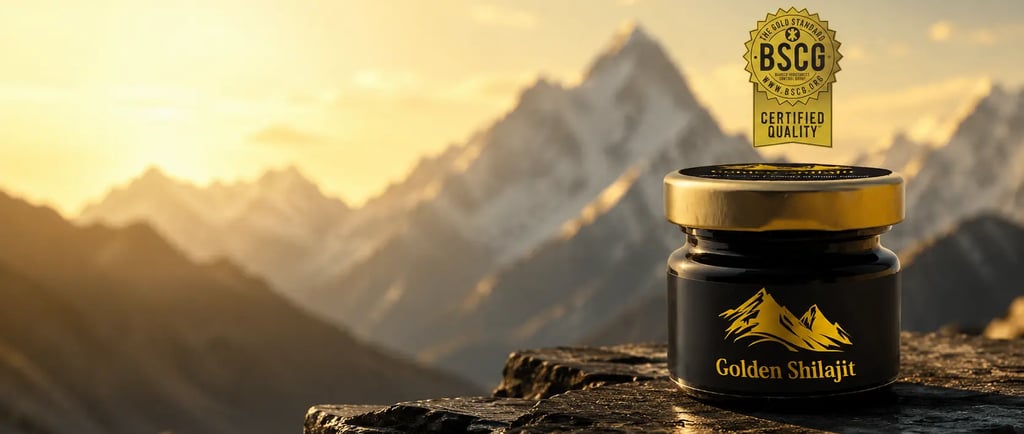
Pakistan is home to some of the most geologically extraordinary mountain terrain on Earth. At the convergence of the Himalayas, the Karakoram, and the Hindu Kush — three of the world's mightiest mountain ranges — lies a region that produces what many researchers and nutraceutical specialists consider the world's finest Shilajit: Gilgit-Baltistan, Pakistan.
In this guide, we cover everything you need to know about Shilajit in Pakistan: where it forms, how it is harvested, what makes Pakistani Shilajit uniquely potent, and how to ensure you're buying the real thing.
What Is Shilajit?
Shilajit is a naturally occurring mineral-rich resin that seeps from rock crevices at high altitudes, particularly during warmer months when the mountain rock expands. It forms over centuries — sometimes millennia — from the slow compression and humification of organic plant matter trapped between rock layers.
The result is a dense, tar-like substance packed with:
Fulvic acid (40–55% in high-quality purified resin)
Humic acid
Over 80 trace minerals including iron, zinc, magnesium, copper, and selenium
Dibenzo-α-pyrones (DBPs) — bioactive compounds unique to Shilajit
The quality of Shilajit is directly tied to the geology, altitude, and climate of where it forms. This is why Pakistan — and specifically Gilgit-Baltistan — produces Shilajit of exceptional potency.
Where Does Shilajit Come From in Pakistan?
Shilajit in Pakistan is found primarily in three interconnected high-altitude regions:
1. Gilgit-Baltistan (GB)
The most prized source. GB sits at the convergence of the Himalayas, Karakoram, and Hindu Kush ranges, with Shilajit harvested at altitudes between 4,000 and 5,500 metres above sea level. The extreme geological pressure at this convergence zone accelerates mineralisation, producing Shilajit with the highest density of fulvic acid and trace minerals.
Key districts include Gilgit, Skardu, Hunza, Ghizer, and Astore — all within the GB region.
2. Karakoram Range
The Karakoram is home to K2, the world's second-highest peak, and several of the world's longest glaciers outside the polar regions. Shilajit found in Karakoram zones benefits from the same extreme altitude and geological compression as GB, and is often considered part of the same high-quality Pakistani Shilajit category.
3. Hindu Kush Foothills (Northern KPK)
Lower-altitude Shilajit is also found in parts of Khyber Pakhtunkhwa (KPK) bordering the Hindu Kush. While still a legitimate source, the lower altitude (typically 2,000–3,500m) means lower geological pressure and generally lower fulvic acid concentration compared to GB.
At Golden Shilajit Official, we source exclusively from Gilgit-Baltistan — the highest-altitude and most mineralogically rich zone in Pakistan.
How Is Shilajit Harvested in Pakistan?
Traditional Shilajit harvesting in Pakistan is a skilled, labour-intensive process passed down through generations of local mountain communities. Here is how it works:
Step 1: Seasonal Identification
Shilajit seeps from rock faces primarily during late spring and summer (May–August), when rising temperatures cause the rock to expand and push the resin to the surface. Experienced harvesters — often from local Balti and Shina communities — know exactly which rock faces and crevices to monitor each season.
Step 2: High-Altitude Collection
Harvesters climb to altitudes of 4,000–5,500 metres, often on foot through difficult terrain, to reach the seepage points. Raw Shilajit is carefully scraped from rock surfaces using traditional tools, collected into containers, and carried back down by hand.
Step 3: Raw Material Assessment
Raw Shilajit at this stage is impure — it contains rock particles, plant debris, and microbial matter. It must be purified before it is safe or effective for human consumption. The colour, texture, and smell of raw Shilajit are assessed by experienced harvesters to determine quality before purification begins.
Step 4: Traditional Water-Based Purification
At Golden Shilajit Official, raw GB Shilajit undergoes a multi-stage traditional water-based purification process:
The raw resin is dissolved in purified water and filtered to remove rock particles and debris
The solution is sun-dried or gently evaporated to concentrate the active compounds
This process is repeated multiple times to achieve maximum purity
No chemical solvents, additives, or artificial processing agents are used at any stage
Step 5: Third-Party Laboratory Testing
Every batch of purified Shilajit is sent to Eurofins Scientific — one of the world's most respected independent analytical laboratories — for comprehensive testing including:
Fulvic acid percentage by dry weight
Heavy metals panel (arsenic, lead, mercury, cadmium)
Microbial safety testing
BSCG certification for banned substance compliance
View our full batch-specific lab reports here: Golden Shilajit Lab Reports
Why Is Pakistani Shilajit Considered World-Class?
Several factors combine to make Gilgit-Baltistan, Pakistan the gold standard for Shilajit globally:
Unmatched Altitude
At 4,000–5,500 metres, GB Shilajit is harvested at higher altitudes than virtually any other source. Higher altitude means greater geological pressure, more extreme temperature cycles, and a longer, more intense mineralisation process — all of which contribute to higher potency.
Triple Mountain Convergence
No other Shilajit-producing region on Earth sits at the convergence of three major mountain ranges. The Himalayas, Karakoram, and Hindu Kush meeting point creates a uniquely mineralised geological environment that is unmatched anywhere else in the world.
Exceptional Mineral Richness
The rock formations of GB are exceptionally rich in iron, zinc, magnesium, copper, selenium, and over 80 trace minerals — all of which are absorbed into the Shilajit resin during its formation over centuries.
Verified Fulvic Acid Content
High-quality purified GB Shilajit consistently tests at 40–55% fulvic acid by dry weight — the highest reliable benchmark in the industry. This is the honest, science-aligned figure; claims above 60% are generally not supported by independent lab data.
Generational Harvesting Knowledge
Local Balti and Shina communities in GB have harvested Shilajit for generations using traditional methods that minimise contamination and preserve the integrity of the resin. This knowledge — passed down through families — is irreplaceable.
How to Buy Authentic Pakistani Shilajit
The global Shilajit market is unfortunately flooded with low-quality, mislabelled, and adulterated products. Here's how to verify you're getting genuine Pakistani Shilajit:
Demand a specific region — "Himalayan" is not enough. Ask for the country and region (e.g., Gilgit-Baltistan, Pakistan)
Request a third-party COA — from a recognised lab such as Eurofins, SGS, or Intertek. Not an in-house test.
Check the fulvic acid percentage — 40–55% is the honest range for premium purified resin. Be sceptical of claims above 60%.
Verify the heavy metals panel — arsenic, lead, mercury, and cadmium must all be within safe international limits
Look for BSCG certification — especially important for athletes and health-conscious consumers
Check the form — authentic high-quality Shilajit is typically sold as a resin, not powder or capsules, which are easier to adulterate
For a detailed guide on reading a Shilajit Certificate of Analysis, see: How to Read a Shilajit Certificate of Analysis
Frequently Asked Questions
Which part of Pakistan produces the best Shilajit?
Gilgit-Baltistan is widely considered the best source, due to its extreme altitude (4,000–5,500m), triple mountain convergence, and exceptional mineral density. Skardu, Hunza, and Gilgit districts are among the most prized harvesting zones.
Is Pakistani Shilajit the same as Himalayan Shilajit?
Pakistani Shilajit from Gilgit-Baltistan is technically part of the broader Himalayan region, but it represents the highest-altitude and most mineralogically rich zone within the Himalayas. Not all "Himalayan" Shilajit comes from Pakistan — the label can refer to sources across India, Nepal, and Tibet as well.
Is raw Pakistani Shilajit safe to consume?
No — raw Shilajit must be purified before consumption. It contains rock particles, heavy metals in unprocessed form, and microbial matter. Always choose purified Shilajit that has been independently tested by a third-party laboratory.
What is the fulvic acid content of Pakistani Shilajit?
High-quality purified Shilajit from Gilgit-Baltistan consistently tests at 40–55% fulvic acid by dry weight when independently verified. This is the honest, science-aligned benchmark — claims above 60% are generally not supported by lab data.
Does Golden Shilajit Official source from Pakistan?
Yes — exclusively. All our Shilajit is sourced from Gilgit-Baltistan, Pakistan, at altitudes between 4,000 and 5,500 metres. Every batch is independently tested by Eurofins Scientific. View our lab reports at /pages/golden-shilajit-lab-report.
Conclusion
Pakistan — and specifically Gilgit-Baltistan — is home to the world's most potent and mineralogically rich Shilajit. The combination of extreme altitude, triple mountain convergence, exceptional geology, and generational harvesting knowledge makes Pakistani Shilajit in a class of its own.
At Golden Shilajit Official, we are proud to source exclusively from this extraordinary region, purify using traditional water-based methods, and verify every batch through independent Eurofins testing — so you can trust exactly what you're getting.
Contact
Follow
info@goldenshilajit.pk
Whatsapp-03348455205
© 2026. Golden Shilajit offcial All rights reserved.
Golden Shilajit Pakistan is a registered brand of Himalayan Innate Pvt Ltd.
Unauthorized sale or distribution is strictly prohibited and will result in legal action.
These statements have not been evaluated by the Food and Drug Administration. This product is not intended to diagnose, treat, cure, or prevent any disease.