Golden Shilajit Official | EUROFINS Tested | Pure Himalayan Shilajit Resin

Golden Shilajit — Authentic Lab-Tested Himalayan Resin 2026
A research-based guide to Golden Shilajit — authentic Himalayan resin, Eurofins lab testing, real fulvic acid ranges, and how to buy with full confidence.
Dr. Hamza Khan specializes in natural compound analysis and supplement verification, with a focus on Himalayan-sourced botanicals and resin authentication. He works closely with Eurofins Laboratories USA to evaluate fulvic acid concentration, heavy metal safety, and sourcing integrity for every batch released by Golden Shilajit Pakistan.
5/26/202616 min read
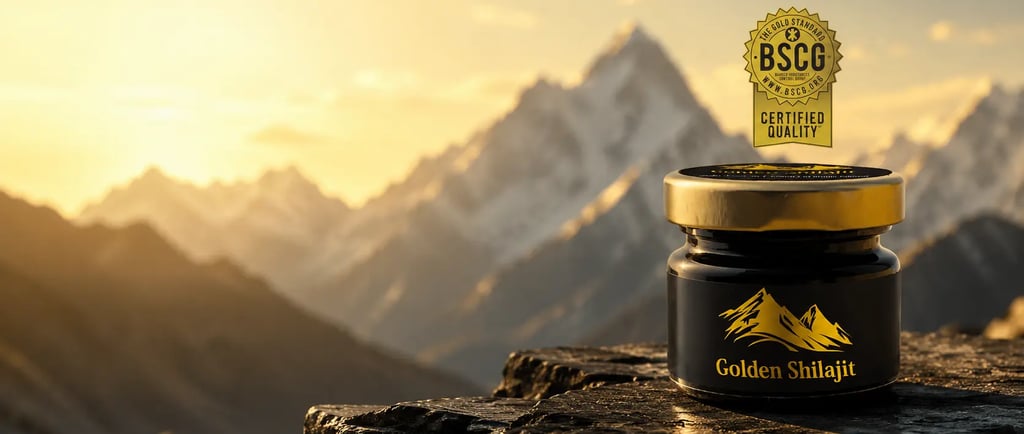
Golden Shilajit: The Complete 2026 Authority Guide to Authentic, Lab-Tested Himalayan Resin
In the global wellness market, few substances have generated as much scientific interest — or as much consumer confusion — as Golden Shilajit. What was once a regional ayurvedic remedy harvested from the high-altitude crags of the Himalayas and Karakoram has become a worldwide phenomenon, studied in peer-reviewed journals, recommended by integrative physicians, and increasingly demanded by performance athletes, longevity researchers, and discerning wellness consumers.
But there's a problem hiding beneath the popularity. The same forces that made shilajit a household name have also made it one of the most counterfeited natural products in the world. For every jar of authentic resin sold, multiple imitations move through unverified channels — undocumented, untested, and in some cases, genuinely unsafe.
This guide is the definitive resource for understanding golden shilajit in 2026: what it actually is, how it's properly sourced, how laboratory science verifies authenticity, and how modern consumers can buy with confidence. Built on analytical research, accredited testing standards, and a transparent view of the industry's flaws, it's written for readers who want to make decisions based on evidence — not marketing.
Table of Contents
What Is Golden Shilajit
Why Authenticity Matters
How Authentic Himalayan Shilajit Is Sourced
Why Purification Matters
Understanding Fulvic Acid
Real vs Fake Shilajit
How Lab Testing Works
Why ICP-MS Testing Matters
Benefits of Authentic Shilajit
How to Use Shilajit Resin
Why Premium Shilajit Costs More
Why Golden Shilajit Pakistan Focuses on Transparency
How Modern Consumers Verify Authenticity
Frequently Asked Questions
Final Buyer Guide
What Is Golden Shilajit
Golden Shilajit is a premium grade of authentic Himalayan shilajit resin — a naturally occurring, mineral-rich substance that seeps from rock crevices at elevations between 3,000 and 5,000 meters across the world's highest mountain ranges. The "golden" designation refers to its hallmark visual signature: when dissolved in warm water, authentic resin produces a luminous golden-brown liquid, a property that distinguishes it from lower-grade or adulterated alternatives.
Geologically, shilajit forms over centuries through the slow biogeochemical transformation of plant matter, mosses, and microbial residues compressed between layers of rock. The result is a dense, tar-like resin containing over 80 trace minerals in ionic form, alongside two principal bioactive compounds — fulvic acid and humic acid — which drive nearly every documented health benefit associated with the substance.
In traditional ayurvedic medicine, shilajit has been referenced for more than three thousand years as a rasayana, or rejuvenating compound, believed to support vitality, longevity, and cellular regeneration. Modern science is now catching up to that ancient framework, with peer-reviewed studies examining shilajit's role in mitochondrial bioenergetics, testosterone regulation, cognitive performance, and exercise recovery.
But the term "golden shilajit" carries one critical implication: it refers exclusively to authentic, properly purified, lab-verified resin. Anything else — paste, powder, or unverified extract — is not the substance being studied in clinical research, and not the product worth your money.
Why Authenticity Matters
The case for authenticity isn't aesthetic. It's biochemical, safety-related, and economic.
Biochemical integrity. The benefits attributed to shilajit — improved energy, mineral absorption, antioxidant activity, cognitive support — depend on the presence of specific bioactive compounds at meaningful concentrations. Fake or adulterated shilajit doesn't just lack these compounds; it actively replaces them with inert or harmful fillers.
Safety profile. Authentic shilajit from clean, high-altitude sources contains minerals in trace amounts well within international safety thresholds. Counterfeit shilajit — often produced from low-altitude soil, industrial bitumen, or contaminated raw material — can contain dangerous levels of lead, arsenic, mercury, and cadmium. These heavy metals bioaccumulate in the body and have been linked to neurological, renal, and cardiovascular damage.
Economic reality. Real shilajit is expensive to harvest, expensive to purify, and expensive to test. When a product is priced suspiciously low, the savings have come from somewhere — and that "somewhere" is usually one of the three pillars of authenticity: source, purification, or verification.
For consumers searching for golden shilajit Pakistan, authentic Himalayan shilajit, or lab tested shilajit, this is the foundational principle: the only shilajit worth consuming is the kind that can prove what it claims to be.
How Authentic Himalayan Shilajit Is Sourced
The journey from mountain to jar is far more involved than most consumers realize, and understanding it is essential to recognizing quality.
Altitude. Genuine shilajit forms only at elevations above 3,000 meters, where the combination of low oxygen, cold temperatures, mineral-rich rock composition, and slow oxidative geochemistry produces the resin's characteristic profile. Pakistan's position at the convergence of the western Himalayas, Karakoram, and Hindu Kush ranges makes it one of the world's most geographically privileged sources.
Harvesting. Raw shilajit is collected by hand from remote cliff faces, often in regions accessible only on foot. Experienced harvesters identify active seepage points — usually visible as glossy black streaks against gray rock — and extract the raw material in small quantities over weeks of work. The yield from any given location is modest, and over-harvesting can permanently deplete a site.
Seasonal timing. The best raw shilajit is harvested during warm-weather months, when the resin seeps most actively from the rock. Off-season harvesting often produces lower-quality material with reduced fulvic acid content.
Initial inspection. Raw shilajit arrives at the purification facility as a heavy, sticky mass mixed with rock fragments, dust, plant debris, and organic matter. None of this raw material is consumable in its harvested state. Without proper purification, it is unsafe.
This is why the source disclosure matters in any premium brand. Original shilajit Pakistan carries meaningful weight only when the brand can name its harvesting region, its altitude range, and its supply chain — vague claims about "premium sources" or "Himalayan origin" without specifics are red flags.
Why Purification Matters
Raw shilajit and consumable shilajit are not the same substance. The purification process — properly done — is what transforms harvested material into the bioactive resin studied in clinical research.
Traditional purification follows a multi-step process refined over centuries.
Step one: aqueous extraction. Raw shilajit is dissolved in pure water at controlled temperatures, allowing the bioactive compounds to enter solution while heavier debris settles.
Step two: filtration. The solution is filtered through progressively finer mesh to remove rock fragments, sand, plant matter, and microbial contamination.
Step three: low-temperature evaporation. This is where shortcuts destroy quality. Proper purification removes water at temperatures below 40°C — typically through sun-drying or low-heat evaporation — to preserve the heat-sensitive fulvic acid molecules. High-heat processing, common in mass-produced shilajit, degrades the very compounds responsible for the product's benefits.
Step four: concentration and curing. The purified liquid is reduced to a thick resin and allowed to cure under controlled conditions, stabilizing the final product for packaging.
The entire process can take two to four weeks per batch and significantly reduces yield — sometimes by half or more. This is the labor and material cost that separates authentic pure shilajit resin from the unverified paste flooding online marketplaces.
Understanding Fulvic Acid
Fulvic acid is the single most important compound in shilajit. Everything that makes the substance valuable — at the cellular, molecular, and systemic level — runs through this one organic acid.
Structurally, fulvic acid is a low-molecular-weight organic compound that acts as a natural chelator. It binds to minerals, transports them across cell membranes, and dramatically increases their bioavailability. This is why shilajit is often described as a "mineral delivery system": the fulvic acid is doing the heavy lifting.
In peer-reviewed research, fulvic acid is studied for its role in:
Mitochondrial energy production and ATP synthesis
Antioxidant activity and oxidative stress reduction
Anti-inflammatory effects through cytokine modulation
Mineral absorption — particularly iron, magnesium, and zinc
Gut microbiome support and intestinal barrier integrity
Cellular hydration and electrolyte transport
Because fulvic acid drives the benefits, its concentration is the single most important measurable property on any shilajit lab report.
Realistic Fulvic Acid Percentages
Here's where the market gets misleading. Online listings routinely claim 70%, 80%, even 90% fulvic acid content. These numbers are almost universally false.
Fulvic Acid Percentage What It Likely Indicates 10% – 20% Possible authentic resin, depending on extraction method 20% – 30% High-quality, properly purified Himalayan resin 30% – 50% Exceptional batch — verifiable only through accredited lab testing 55% – 90% Almost certainly fabricated or measured using unreliable methods
Authentic Himalayan shilajit, when tested using validated methods such as the Lamar method or ISO 19822, typically falls between 10% and 30% fulvic acid. Exceptional batches verified by accredited international laboratories may reach 30%–50%, but anything above 55% should be treated as fabricated.
When a seller claims 80%+ fulvic acid, one of three things is happening: they're using non-standard testing that inflates results, they're confusing fulvic acid with total humic substances, or they're simply inventing numbers.
The principle for buyers is straightforward: don't chase the highest percentage. Chase the most credible verification.
Real vs Fake Shilajit
The difference between authentic shilajit resin and counterfeit paste isn't subtle once you know what to look for. Several physical, sensory, and documentary markers separate the two reliably.
Texture. Authentic golden shilajit is firm, glossy, and semi-solid at room temperature. Fake pastes are typically soft, sticky, and oily — a sign of glycerin, wax, or emulsifier-based fillers.
Heat response. Real resin softens and becomes pliable in warm hands within 30 to 60 seconds. Counterfeit pastes either remain stubbornly uniform or melt unevenly into a greasy film.
Cold response. Genuine shilajit hardens and becomes brittle when refrigerated — you can snap a chilled piece. Fake products stay gummy or rubbery because their fillers don't respond to temperature.
Water solubility. Authentic resin dissolves completely in warm water, producing a translucent golden-brown to dark amber liquid with no residue. Fake shilajit leaves an oily film, sediment, or cloudy suspension.
Smell. Real shilajit has an unmistakable earthy, smoky aroma with bitter undertones — never sweet, never chemical. Fakes are often odorless or oddly sweet from added jaggery or molasses.
Taste. Genuine resin is intensely bitter and mineral-forward, with a complexity that lingers. Fake shilajit tastes sweet, salty, or simply flavorless.
The burn test. Authentic shilajit bubbles gently when exposed to flame and produces a light ashy residue without igniting. Counterfeit products containing bitumen, plastic, or wax will catch fire, produce black smoke, or release chemical odors.
Lab documentation. Real shilajit comes with a current ICP-MS heavy metal report and fulvic acid certification from an accredited laboratory. Fake shilajit either has no documentation or relies on vague self-issued claims.
Color when dissolved. Authentic shilajit produces a translucent golden-brown liquid through which light passes. Fake shilajit produces a black, cloudy, or muddy solution.
How Lab Testing Works
Modern shilajit verification rests on independent laboratory analysis — a system of checks designed to confirm what a brand claims about its product.
A complete shilajit lab analysis typically includes the following panels.
Heavy metals analysis identifies and quantifies the presence of lead, arsenic, mercury, and cadmium using ICP-MS technology. Results are compared against international safety thresholds set by the US Pharmacopeia, European Pharmacopoeia, or WHO.
Fulvic and humic acid quantification measures the concentration of bioactive compounds using validated analytical methods. The Lamar method and ISO 19822 are the most accepted standards.
Microbiological screening tests for yeast, mold, E. coli, Salmonella, and total aerobic bacterial counts.
Moisture and ash content evaluates physical composition and confirms proper purification.
Pesticide and solvent residue testing screens for agricultural and industrial contamination.
A credible laboratory issues a multi-page report with sample identification numbers, analytical methodologies, results tables, reference values, and authorized signatures. Reports issued by accredited laboratories like Eurofins carry weight precisely because the lab has no commercial stake in the outcome.
You can examine real examples of accredited lab documentation at goldenshilajit.pk/shilajit-lab-report to understand what proper third-party verification looks like in practice.
Why ICP-MS Testing Matters
ICP-MS — Inductively Coupled Plasma Mass Spectrometry — is the international gold standard for detecting trace elements and heavy metals at extremely low concentrations, measured in parts per billion.
The technique works by ionizing a sample in a high-temperature plasma, then passing the ions through a mass spectrometer that identifies and quantifies each element by atomic mass. It can detect over 70 elements simultaneously with exceptional accuracy.
For shilajit, ICP-MS testing measures four critical heavy metals:
Lead (Pb) — neurotoxic, particularly dangerous for children and pregnant women
Arsenic (As) — carcinogenic, linked to skin, lung, and bladder cancers
Mercury (Hg) — neurotoxic, damages the nervous system and kidneys
Cadmium (Cd) — accumulates in kidneys, classified as a human carcinogen
The reason this matters specifically for shilajit is that the substance itself is a mineral concentrate. Because it forms from rock and organic matter, shilajit absorbs whatever is in its environment. Clean, high-altitude sources produce mineral-rich, safe resin. Contaminated or low-altitude sources can produce material that exceeds international safety thresholds.
Heavy metal tested shilajit is not a marketing phrase. It's the minimum safety bar for a substance whose entire reason for existing is its mineral content.
A 2023 analytical review published in the Journal of Ayurveda and Integrative Medicine found that a significant portion of commercial shilajit samples in South Asia exceeded international safety thresholds for heavy metals. The samples that passed were almost exclusively those from verified high-altitude sources subjected to proper aqueous purification — and confirmed by accredited laboratory testing.
Benefits of Authentic Shilajit
The benefits associated with shilajit in modern research apply only to authentic, properly purified, lab-verified resin. With that caveat established, here's what the evidence actually supports.
Mitochondrial energy support. Fulvic acid and dibenzo-α-pyrones in authentic shilajit support ATP production, the body's primary cellular energy currency. Studies suggest regular supplementation may reduce fatigue and improve physical endurance.
Mineral bioavailability. The chelating properties of fulvic acid significantly improve the absorption of essential minerals — iron, magnesium, zinc, selenium — making shilajit particularly relevant for individuals with mineral deficiencies.
Antioxidant activity. Authentic shilajit contains compounds that reduce oxidative stress and support the body's natural antioxidant defenses, with implications for cellular aging and chronic inflammation.
Cognitive support. Preliminary research suggests fulvic acid may help protect neurons from oxidative damage and support cognitive function, though larger clinical trials are needed.
Testosterone modulation. Several studies have examined shilajit's role in supporting healthy testosterone levels in men, particularly when combined with the trace minerals zinc and selenium.
Exercise recovery. Athletes and active individuals report improved post-exercise recovery, likely linked to shilajit's mitochondrial and anti-inflammatory effects.
Immune and gut support. The mineral and acid complex in authentic resin supports digestive health, mineral absorption, and immune system function.
Importantly, these benefits develop gradually with consistent use of authentic product. Anyone promising overnight transformation is selling marketing, not science.
How to Use Shilajit Resin
Using authentic shilajit resin properly is straightforward, but a few principles maximize results and safety.
Recommended daily amount. A pea-sized portion (approximately 300–500 mg) once or twice daily is the standard dosage for most adults. New users should start at the lower end and assess tolerance before increasing.
How to consume. Dissolve the resin in warm (not hot) water, milk, or herbal tea. Stir until fully dissolved, then drink immediately. The bitterness is unavoidable and is, in fact, evidence of authenticity.
Timing. Many users prefer morning consumption for energy support. Others use it before workouts or in the early evening. Avoid consuming directly before sleep, as the energy effects may interfere with rest.
Consistency. Shilajit produces gradual, cumulative benefits. Daily use for at least four to eight weeks is typically required to assess effects fully.
Storage. Keep the resin in its original sealed glass container at room temperature, away from direct sunlight and humidity. Properly stored, authentic resin has an extremely long shelf life — often several years — due to its naturally preservative composition.
Safety considerations. Pregnant or nursing women, children, and individuals on prescription medications should consult a qualified healthcare provider before use. Stop use if any unusual reactions occur.
Why Premium Shilajit Costs More
The price gap between authentic and counterfeit shilajit reflects real differences in production, not branding inflation. Understanding the economic structure helps consumers evaluate fair pricing.
Harvesting costs. Hand-collection at high altitudes is labor-intensive and dangerous work. Harvesters operate in remote terrain, often spending weeks gathering modest quantities.
Purification costs. Proper aqueous purification with low-temperature evaporation can take two to four weeks per batch and reduces yield by 50% or more.
Testing costs. Accredited testing through laboratories like Eurofins costs hundreds of dollars per panel. Brands testing every batch absorb a meaningful per-gram cost that uncertified sellers simply skip.
Packaging and traceability infrastructure. Glass containers (plastic can leach into resin), batch numbers, harvest dates, and QR-code-linked lab reports all add legitimate costs.
Brand accountability. Operating transparently — publishing lab reports, supporting customers, honoring guarantees — requires infrastructure that fly-by-night sellers don't maintain.
When you see a price gap between unverified shilajit and properly produced, lab-tested resin, you're seeing the actual cost of integrity. You can review pricing for verified, lab-tested products at goldenshilajit.pk/collections/all to understand what reasonable pricing looks like for genuine product.
Why Golden Shilajit Pakistan Focuses on Transparency
In an industry plagued by counterfeit products, transparency is the most valuable currency a brand can offer. Golden Shilajit Pakistan has built its operation around this principle.
Published lab reports. Every batch is tested by Eurofins Laboratories USA, an internationally accredited testing facility. The full reports — including ICP-MS heavy metal panels and validated fulvic acid quantification — are published openly at goldenshilajit.pk/shilajit-lab-report for any consumer to review.
Disclosed sourcing. The raw material comes from verified high-altitude regions of the Karakoram and western Himalayas. The brand discloses its source range rather than hiding behind vague claims.
Standardized purification. Each batch follows traditional aqueous purification with low-temperature evaporation, preserving the fulvic acid concentration that defines authentic resin.
Batch traceability. Every jar carries a batch number that links directly to its corresponding lab report — meaning consumers can verify the specific product they purchased, not a generic claim about the brand.
Regulatory compliance. The brand operates under ISO 22000, GMP, and halal certifications, ensuring international quality and safety standards.
This isn't transparency as marketing. It's transparency as infrastructure — the only credible answer to a marketplace where most sellers offer none of these guarantees.
How Modern Consumers Verify Authenticity
Today's informed shilajit buyer has more tools than ever to confirm authenticity before purchase. Here's the modern verification framework.
Step one: demand published lab reports. A brand that doesn't publish lab documentation openly is signaling something about its product. Reports should include heavy metal results, fulvic acid quantification, and microbiological screening from a named, accredited laboratory.
Step two: verify the laboratory. Confirm that the testing facility is independent and internationally accredited. Eurofins, SGS, and other ISO/IEC 17025 accredited labs carry meaningful weight. In-house "tests" do not.
Step three: cross-check the report. Real lab reports have sample IDs, dates, methodologies, and signatures. They run multiple pages. A single-image "certificate" without detail is almost always fabricated.
Step four: examine the product. Use the physical tests outlined earlier — water dissolution, heat response, taste, smell, and behavior under cold. Authentic resin passes all of them consistently.
Step five: review batch traceability. Real brands can connect the jar in your hand to a specific lab report. Generic "brand-wide" claims without batch-specific verification are insufficient.
Step six: check the brand's content. Educational brands that explain methodology, sourcing, and testing transparently demonstrate expertise that vanity brands cannot fake.
Step seven: examine packaging. Glass containers, clear labeling, batch numbers, and expiry dates are standard for premium products. Plastic containers, hand-packaged tubs, and unlabeled jars are warning signs.
A brand that satisfies all seven criteria — like the verified offerings at goldenshilajit.pk — operates at the top tier of the global shilajit market. Anything less involves risk that's no longer necessary in 2026.
Frequently Asked Questions
What is Golden Shilajit? Golden Shilajit is a premium grade of authentic Himalayan shilajit resin sourced from high-altitude mountain regions, purified through traditional aqueous methods, and verified by accredited international laboratories. The "golden" designation refers to its characteristic golden-brown color when dissolved in warm water — a visual marker of authentic, properly purified resin.
Is Golden Shilajit safe for daily use? Yes, when sourced from verified high-altitude regions and tested for heavy metals by an accredited laboratory like Eurofins. Authentic, lab-tested shilajit is generally considered safe for long-term daily use at recommended dosages of 300–500 mg, once or twice per day.
What makes Golden Shilajit different from other shilajit products? Golden Shilajit operates under full transparency — every batch is tested by Eurofins Laboratories USA, lab reports are published openly, batch traceability is maintained, and sourcing is disclosed. This level of verification is the exception rather than the norm in the global shilajit market.
What is fulvic acid and why does it matter? Fulvic acid is a low-molecular-weight organic compound that acts as a natural chelator, binding to minerals and transporting them across cell membranes with high bioavailability. It's the primary bioactive compound in shilajit and the molecule responsible for most of its documented health benefits.
What's a realistic fulvic acid percentage in real shilajit? Authentic Himalayan shilajit typically contains 10%–30% fulvic acid when measured by validated methods like the Lamar method or ISO 19822. Exceptional batches verified by accredited laboratories may reach 30%–50%, but claims above 55% are almost always fabricated.
Why does heavy metal testing matter for shilajit? Because shilajit absorbs minerals from its surrounding rock, it can contain dangerous levels of lead, arsenic, mercury, or cadmium if sourced from contaminated regions or improperly purified. ICP-MS testing through accredited laboratories ensures these metals are below international safety thresholds.
What is ICP-MS testing? ICP-MS stands for Inductively Coupled Plasma Mass Spectrometry — the international gold standard for detecting heavy metals and trace elements at parts-per-billion concentrations. It is the most accurate method available for verifying the safety of mineral-rich supplements like shilajit.
How can I tell if shilajit is real or fake? Authentic shilajit dissolves completely in warm water producing a golden-brown color, has a bitter mineral taste, softens in heat and hardens in cold, and is backed by accredited lab reports. Fake shilajit leaves residue when dissolved, tastes sweet or chemical, doesn't respond to temperature, and lacks verifiable testing.
Where does authentic Himalayan shilajit come from? The highest-quality shilajit is harvested at elevations above 3,000 meters in the Karakoram, western Himalayas, and Hindu Kush ranges. Pakistan sits at the geographic heart of these regions, making it one of the world's most privileged sources.
How should I store shilajit resin? Store in the original sealed glass container at room temperature, away from direct sunlight and humidity. Authentic resin has an extremely long shelf life — often several years — due to its naturally preservative mineral and acid composition.
Can shilajit be taken with other supplements? Generally yes, but anyone taking prescription medications, iron supplements, or other mineral-based products should consult a qualified healthcare provider to avoid interactions or absorption issues.
How long does it take to see results? Authentic shilajit produces gradual, cumulative effects. Most users report noticeable improvements in energy, recovery, and overall well-being after four to eight weeks of consistent daily use.
Final Buyer Guide
If this guide condenses to a single principle, it's this: in 2026, there is no excuse for buying unverified shilajit. The science is available. The testing infrastructure exists. The reputable brands publish their results openly. The only thing standing between you and authentic, safe, effective resin is the discipline to demand verification before you buy.
Here's the buyer's framework, distilled to its essentials.
Demand lab documentation. ICP-MS heavy metal panels and validated fulvic acid quantification from accredited laboratories like Eurofins. If it's not published, treat it as nonexistent.
Reject unrealistic claims. Fulvic acid percentages above 55% are fabrications. Anything between 60%–90% is marketing fiction. Even claims in the 30%–50% range require full third-party verification to be credible.
Trust resin behavior, not marketing language. Authentic shilajit responds to heat, dissolves cleanly in water, tastes bitter, and smells earthy. These physical properties are difficult for counterfeiters to replicate consistently.
Pay for traceability, not branding. The premium for verified shilajit covers harvesting integrity, purification quality, accredited testing, and batch documentation — not influencer marketing or luxury packaging.
Choose a long-term supplier. Once you find a brand whose lab reports check out, whose product passes physical tests, and whose customer service is responsive, stick with them. The cost of switching to an unverified alternative is rarely worth the marginal savings.
The global market for golden shilajit has matured. The brands operating at the highest standard — those publishing Eurofins lab reports, sourcing from verified high-altitude regions, and offering full batch traceability — have made it possible for consumers anywhere in the world to access the same quality of shilajit available at the top of the industry.
Your responsibility, as the buyer, is simple. Ask for the documentation. Verify it carefully. And only then, open the jar.
Related Articles — Golden Shilajit Pakistan
Continue your research with these verified guides on authentic, lab-tested shilajit.
Shilajit Benefits & Composition The science behind authentic shilajit — minerals, fulvic acid, and what makes pure resin effective.
Fulvic Acid Benefits — Eurofins USA Verified Real fulvic acid ranges in authentic shilajit and how to spot inflated lab claims.
Official Lab Reports — Eurofins Tested View verified ICP-MS heavy metal and fulvic acid lab reports for every batch.
Pure Shilajit — Lab-Tested Himalayan Resin What "pure" really means — sourcing, purification, and certified safety standards.
Shilajit Dosage Guide Safe daily dosage, timing, and best practices for long-term use.
Shop All Golden Shilajit Products Browse the complete range of lab-tested resin and drops with full batch documentation.
Contact
Follow
info@goldenshilajit.pk
Whatsapp-03348455205
© 2026. Golden Shilajit offcial All rights reserved.
Golden Shilajit Pakistan is a registered brand of Himalayan Innate Pvt Ltd.
Unauthorized sale or distribution is strictly prohibited and will result in legal action.
These statements have not been evaluated by the Food and Drug Administration. This product is not intended to diagnose, treat, cure, or prevent any disease.